How to price cabinet jobs without guessing
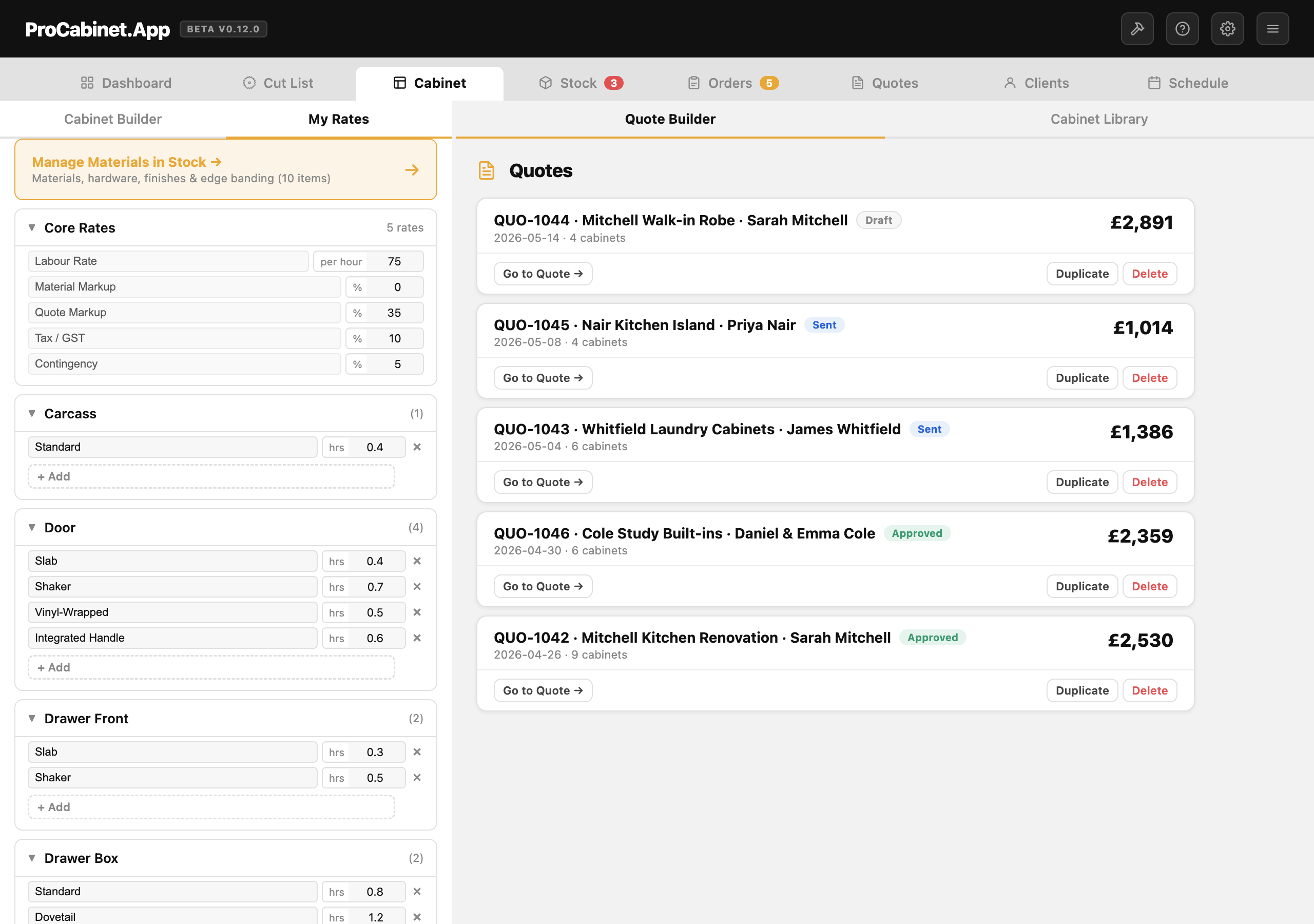
Price a cabinet job in three parts: materials costed from current supplier prices with a 15 to 20% markup, every workshop hour charged at a rate that covers your overheads, and fitting priced as its own line. Write the method down once and apply it to every job, no exceptions.
I priced by feel for years and it cost me dearly, a story I have told in full in how I stopped underpricing my work. This post is the method I use now; it fits on a page and works in a spreadsheet or in software.
What should a cabinet maker charge per hour?
Work it out backwards from your own costs, not sideways from what the shop down the road charges. Their rent is not your rent.
Start with a year of overheads, every cost that exists whether or not you sell a single cabinet. Here is my last full list:
| Overhead | Per year |
|---|---|
| Workshop rent | £7,800 |
| Power | £1,900 |
| Insurance | £1,100 |
| Van | £3,600 |
| Machinery, blades and sharpening | £1,600 |
| Software and phone | £900 |
| Sundries, never predictable, always spent | £1,100 |
| Total | £18,000 |
Then be honest about billable hours. I was in the workshop 40 hours a week, but only about 25 of them were on paying jobs; the rest went on quoting, suppliers, sweeping up and collections. Call it 1,300 billable hours a year once holidays are counted. £18,000 divided by 1,300 is £13.85 an hour just to open the doors. Add the wage you want to take home, £27,500 in my case, which is another £21.15 an hour. That made my rate £35.
If your number feels uncomfortably high, good. The overheads are real whether you charge for them or not, and every hour billed below that line comes straight out of your wage.
How do you cost materials for a cabinet job?
From a current supplier price list, never from memory; prices drift upward quietly and memory does not. Keep one dated list of the materials you actually use, and treat any price older than three months as suspect. Count everything: sheet material, bought-in fronts, hinges, runners, handles, banding, screws, glue and finish. The small stuff looks like nothing per item and comes to £90 or more on a kitchen.
Count waste too, because you buy sheets, not the theoretical area of the parts. If the panels add up to thirteen and a half sheets, you will still open 15 once grain direction and the saw kerf have had their say. In the kitchen example below, the theoretical area would put £648 of board on the quote; the 15 sheets actually bought cost £720, and if you quote the smaller number the £72 comes out of your wage. I have put proper numbers on shrinking that waste in how to reduce plywood waste with nesting.
My price list lived in a spreadsheet tab for years, and cabinet software or spreadsheets is my honest take on when each one is enough.
Should you price labour per cabinet or per job?
Per cabinet type, always. A whole-job guess like "about two weeks" hides everything, which is why it feels comfortable. Mine settled at 6 hours of workshop time for a standard base unit and 5 for a wall unit, carcass built, fronts hung, hardware fitted; drawer stacks, corner units and anything with an angle carried their own, higher numbers. Fitting stays separate, priced per day, because a day on site has different costs from a day at the bench. The one rule is that per-cabinet hours come from recorded time on finished jobs, written on a clipboard by the bench, because quoting imagined hours was the single biggest leak in my own pricing.
What markup should you put on materials?
Between 15 and 20% for a small shop; it is not padding. It covers your time ordering and collecting, the money tied up between paying the merchant and being paid yourself, the board that turns out bowed, and the warranty repair two years on. Below 10% you are effectively lending customers money for free; much above 25% the markup is usually compensating for an hourly rate set too low.
Keep the markup and the overhead recovery inside the rate as separate, visible numbers, because when a job pays worse than quoted you need to know which line failed. Hours running over is an estimating problem; materials outrunning the markup is a buying problem. One blended "add 30% and hope" figure can never tell you, so the same mistake gets made twice.
How do you price a full kitchen, start to finish?
Here is a straightforward example: a 12-cabinet kitchen, 8 base and 4 wall units, 18mm MFC carcasses with sprayed fronts bought in.
| Line | Working | Amount |
|---|---|---|
| Sheet material | 15 sheets of 18mm MFC at £48 | £720 |
| Doors and drawer fronts | bought in, sprayed | £1,150 |
| Hardware | hinges, runners, handles | £340 |
| Edging and consumables | banding, screws, glue | £90 |
| Materials subtotal | £2,300 | |
| Materials markup | 20% of £2,300 | £460 |
| Workshop labour | 68 hours at £35 | £2,380 |
| Fitting | 2 days at £280 | £560 |
| Quote total | £5,700 |
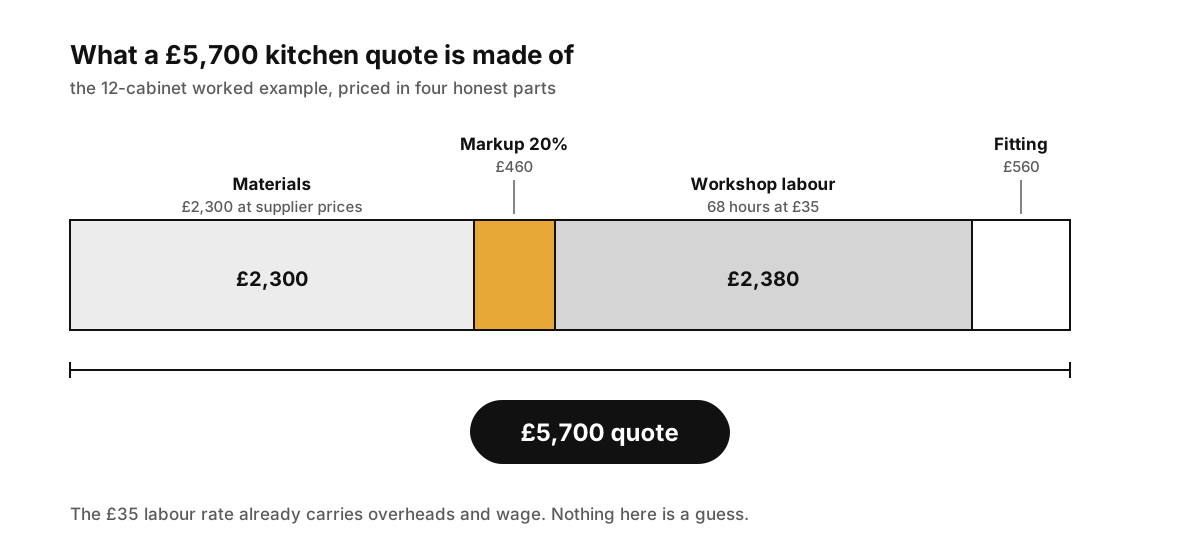
The labour line is 8 base units at 6 hours and 4 wall units at 5, and it is still the number to distrust. Materials are checkable; hours are where optimism hides, which is why the per-cabinet figures come from recorded jobs, not the build I imagine going perfectly. Sanity-check the finished number against comparable local work, after the sum and never instead of it, and if you move a price to win a job, do it as a visible discount so the quote still shows the true number.
Do that sum in a spreadsheet and it works. The catch is keeping it current: when MFC goes up or your rate changes, every saved template still holds the old numbers. That maintenance job is the main thing I built ProCabinet to remove: set your rates once in My Rates and quotes price themselves from them, so a change reaches the next quote without re-editing templates. Declared interest, it is my tool; the detail is on the features page and the plans on the pricing page.
Should you show the customer the price breakdown?
Show totals and choices, not workings. One figure for the supplied kitchen, one for fitting, and options priced as their own lines the customer can take or leave. Never show the hourly rate or the markup; customers compare rates out of context, and they cannot compare your overheads. The exception I make is the deposit: make paying it easy, even by card. Card payments carry a fee, which I have set out plainly on the payment fees page, but a deposit paid the same day beats an unpaid one with no fee.
Common questions
What margin should a cabinet shop make?
There is no official number; for years mine was accidental, whatever was left when the job closed. Pricing deliberately, I aimed for roughly 10% of the job price left after materials, my wage at the full rate and every overhead. The figure matters less than margin being decided on the quote rather than discovered afterwards. If nothing is ever left, the fault is usually the rate or the hours, not the markup.
Should I charge for quoting?
Not for a straightforward kitchen priced from a survey and a conversation; the cost of quoting sits in your overheads, which is why the unpaid hours were counted when the £35 rate was built. Design-heavy work is different. Drawings a customer could carry to another workshop are work product, so I priced the design stage as its own small job and credited it against the build when it went ahead.
How do I price against big-box cabinets?
Not head-on. A flat-pack range from a national retailer is priced on a volume no workshop will ever have, so matching it means paying for the privilege of working. Price your normal way, then help the customer compare like with like: the big-box figure usually excludes survey, fitting, scribing to walls that are not square, and anyone answering the phone afterwards. The customers who ring a maker usually already want what the box cannot do, a kitchen built to their room.
Try ProCabinet free. Every account starts with 14 days of Pro — no card needed. Set your rates once, then quote, cut, schedule and bill from one place.
Start free